Australian packaging regulations 2026 have taken a turn that many in the industry did not expect. In August, the federal government confirmed it will not introduce a new Commonwealth packaging scheme in its current term, even though national packaging reform had been promised by federal, state and territory ministers. For importers, brand owners and sourcing teams in Australia, the US and the EU, the question is practical: what actually changed, what still applies, and how should you plan your packaging? This article sets out the confirmed facts, the reactions, and our view of what it means for overseas packaging suppliers, including manufacturers in Vietnam.
What happened: the facts in order
The decision came out in two steps. According to reporting by Renew Economy, summarized by several trade outlets, Environment Minister Murray Watt told members of the Australian Council of Recycling (ACOR) at a meeting in Canberra on 12 August 2026 that a new national scheme, including mandated recycled content, would not go ahead this term. The Department of Climate Change, Energy, the Environment and Water (DCCEEW) then confirmed it in writing to consultation participants at the start of September.
As reported by PKN Packaging News, the department wrote that a new Commonwealth scheme for packaging “will not be introduced in this term of Government.” It said the government is weighing reforms that balance environmental outcomes against economic and cost-of-living pressures, and will work with state and territory governments on nearer-term improvements instead.
In practice, Australian packaging regulations 2026 will not include a national packaging scheme that needs new Commonwealth legislation or regulation, and none will arrive before the next federal election. Changes made jointly with the states and territories are still possible.
What had been promised
The background matters, because this is why many in the industry describe the decision as a step back:
- 2022: Australia’s environment ministers agreed that packaging should be designed for recovery, reuse and recycling.
- 2023: Federal, state and territory ministers committed to National Packaging Reform, a set of nationally consistent rules on packaging design, recyclability and recycled content.
- Late 2024: Public consultation on reform options closed. A Circular Economy Framework was released in December 2024, and the recycling industry expected recycled-content mandates by the end of 2025.
- 2026: Instead of a mandatory scheme, the federal government deferred it.
Why it matters: the 2025 targets were missed
Australia has had voluntary National Packaging Targets for 2025 since 2018. Data from the Australian Packaging Covenant Organisation (APCO), released in December 2025 and cited by independent analysts, showed plastic packaging recycling at about 20% against a 70% target, and average recycled content at 44% against a 50% target. Supporters of mandatory rules argue that targets without obligations have not delivered.
How industry reacted
The response from the packaging and recycling sectors was strongly negative, but not uniform in tone.
- APCO, which runs the Australian Packaging Covenant, said in its official response that it was disappointed. CEO Chris Foley said APCO’s support for a national scheme has not changed, and that its priority now is to make the current framework work harder for members.
- Recyclers warned that investment is being stranded. Recycling Plastics Australia, an Adelaide processor that received AUD 20 million from the federal Recycling Modernisation Fund in 2024, entered voluntary administration on 31 August 2026, with about 60 jobs reported at risk. ACOR’s chief executive Suzanne Toumbourou described the sector’s viability, especially for plastic packaging, as on an unsustainable path.
- Consultants and economists challenged the cost-of-living reasoning. Modelling by APCO and MRA Consulting estimated a well-run scheme would cost about 0.3 cents per packaging item, or roughly 20 Australian cents on an average weekly shop, before indirect savings.
The government’s position is that households and businesses are already under cost pressure, and that near-term work with the states is the more realistic path.
What still applies: Australian packaging regulations 2026
This is the most important point for buyers: the decision did not remove any existing obligation. It only postponed new ones.
- The co-regulatory system stays. The National Environment Protection Measure (Used Packaging Materials) and the Australian Packaging Covenant remain in force. Brand owners with annual turnover above AUD 5 million must either sign the Covenant and report each year, or be regulated directly by their state. Almost all choose the Covenant.
- Design guidance is still coming. DCCEEW has received a revised Design for Kerbside Recyclability Grading Framework. No decision has been made on how it will apply, but it could guide the existing system.
- Ministers kept packaging on the agenda. At the Environment Ministers’ Meeting on 18 September 2026, ministers agreed a Circular Economy Roadmap that calls packaging reform an urgent and critical priority. Over the next six months they plan to examine options to strengthen the NEPM and the Covenant, including recyclable design, recycled content outcomes, liability thresholds and labelling. Within two years, subject to parliament, they plan to amend the National Environment Protection Council Act 1994 to support updated arrangements.
In short, the direction of Australian packaging regulations 2026 and beyond has not changed. The timeline has slowed, and the tool may shift from a new federal law to a stronger version of the system that already exists.
Our view: what this means for packaging buyers and suppliers
The analysis below is our own reading of Australian packaging regulations 2026 and related rules in other markets. It is not legal advice, and buyers should confirm obligations for their own products.
For brand owners and importers selling into Australia
- Do not pause recyclability work. Covenant reporting continues, and the roadmap points to design and recycled content outcomes being added to the existing system. Packaging you redesign now is unlikely to be wasted.
- Use the Design for Kerbside Recyclability framework as a reference. Even without a mandate, it is the clearest signal of what “good” will look like.
- Expect state-level differences. With the Commonwealth stepping back, more action may come through state and territory cooperation.
For multi-market brands (Australia, EU and US)
Australia’s pause does not lower the bar for global packaging. The EU’s Packaging and Packaging Waste Regulation (PPWR) started to apply on 12 August 2026, the same week as Australia’s announcement. It applies directly in all 27 member states and covers all packaging placed on the EU market, regardless of where it was made. From that date, food-contact packaging containing PFAS above set limits cannot be placed on the EU market.
In the US, the picture is mixed. California withdrew its draft SB 54 regulations in January 2026 for further revision, but the law itself remains in effect and the state says its statutory deadlines are unchanged. Several US states have also banned intentionally added PFAS in some food packaging.
For brands that buy one packaging specification for several markets, the practical move is to design to the strictest market you sell into, which today is usually the EU. That spec will also cover Australia’s likely future requirements.
For packaging suppliers in Vietnam and other export countries
- Demand for recyclable fiber packaging is not going away. Australian buyers still report under the Covenant, and EU buyers now face binding rules. Mono-material paper and corrugated packaging that goes into standard kerbside recycling is easier to justify than mixed plastic structures.
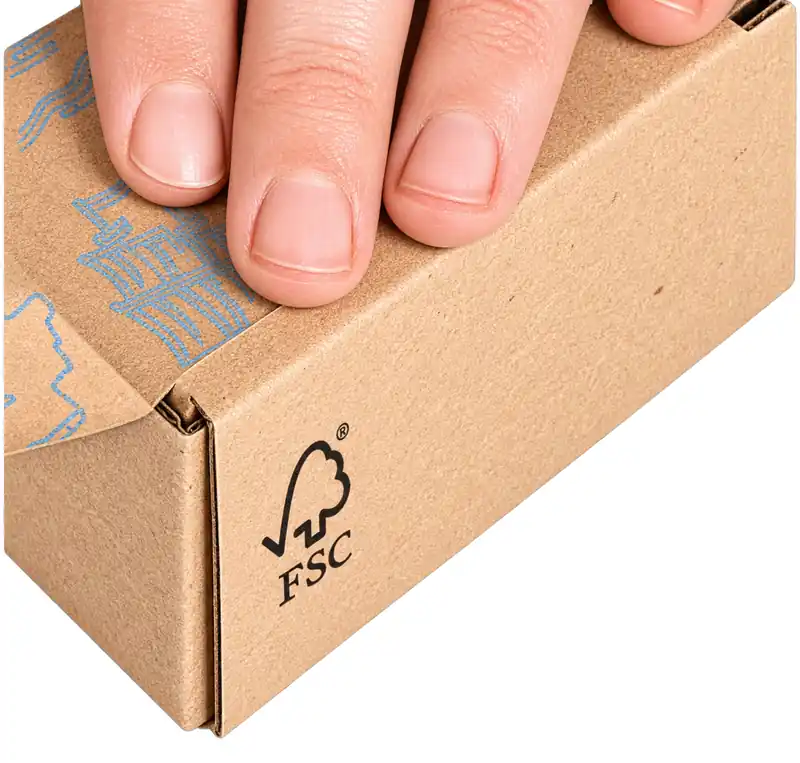
- Documentation is becoming part of the product. Buyers increasingly ask for material composition, recycled fiber content, certification (such as FSC chain of custody) and food-contact declarations. Suppliers who can provide these quickly will be easier to approve.
- Know your own home rules. Vietnam’s EPR framework was consolidated in Decree 110/2026/ND-CP, effective 25 May 2026. Packaging made solely for export is among the listed exemptions, but packaging sold in Vietnam is covered, so suppliers serving both markets need to track both.
- Plastic-to-paper conversions may slow in Australia, not stop. Without recycled-content mandates, some Australian brands may delay switching. EU-driven redesigns will likely continue, and many global brands use one design worldwide.
A practical checklist for buyers sourcing packaging from Vietnam
If you import cartons, boxes or paper bags for the Australian, EU or US market, these are the specs and documents worth confirming with any supplier:
| Item | What to ask for | Why it matters now |
|---|---|---|
| Material structure | Board grade, flute (B, C, E, BC), GSM, coatings and laminations | Mono-material fiber is easier to classify as recyclable under the AU design framework and EU PPWR |
| Recycled content | Percentage of recycled fiber, with supporting mill data | Needed for Covenant reporting and EU recycled content tracking |
| Coatings and inks | Water-based inks, PFAS-free grease or moisture barriers | EU PFAS limits for food-contact packaging apply from 12 August 2026 |
| Certification | FSC chain of custody, ISO quality management | Supports sustainability claims buyers make to retailers |
| Labelling | Space for recycling labels and market-specific marks | Labelling is one of the areas Australian ministers plan to review |
| Commercial terms | MOQ, sample lead time, production lead time, FOB or CIF price in USD | Lets you compare suppliers on a like-for-like basis |
For fresh produce exporters, the same logic applies to export cartons. A ventilated corrugated carton for dragon fruit or mangoes, for example a 40 x 30 x 15 cm (15.7 x 11.8 x 5.9 in) carton holding around 5 kg (11 lb), can be specified as a fully recyclable fiber pack with water-resistant coatings, as long as the coating type is documented.
Sourcing paper packaging from Vietnam: what to expect
Vietnam is a common sourcing base for corrugated cartons, folding boxes and paper bags shipped to Australia, the US and Europe. Typical points to plan for:
- Lead time: samples usually come first, followed by mass production; agree both dates in writing before artwork approval.
- Shipping: flat-packed cartons ship efficiently in 20ft or 40ft containers.
- Incoterms: FOB from Ho Chi Minh City or Hai Phong is common; CIF or DDP can be arranged depending on the supplier.
- Documents: commercial invoice, packing list, certificate of origin, and any material or food-contact declarations your market requires.
Why work with Binh Minh P.A.T (BMP)
BMP is a carton box manufacturer in Vietnam producing corrugated cartons, printed boxes, paper bags and display stands for export and domestic customers. Our focus is fiber-based packaging, which fits the recyclability direction now set in the EU and expected in Australia.
- Corrugated and offset-printed packaging, including fresh fruit export cartons and custom food packaging boxes.
- Certifications and factory audits listed on our certification page.
FAQ
Did Australia cancel packaging reform completely?
No. The federal government said a new Commonwealth packaging scheme will not be introduced in this term. The existing NEPM and Australian Packaging Covenant still apply, and in September 2026 environment ministers agreed to examine ways to strengthen those arrangements, including design, recycled content and labelling.
Do Australian importers still have packaging obligations?
Yes. Under Australian packaging regulations 2026, businesses with annual turnover above AUD 5 million that place packaged goods on the Australian market must meet the Used Packaging Materials NEPM, usually by joining the Australian Packaging Covenant and reporting each year. The September 2026 decision did not change this.
Why did the government delay the scheme?
The department said it is weighing reforms that balance environmental outcomes against economic and cost-of-living pressures. Industry groups dispute the cost argument, citing modelling of about 0.3 cents per packaging item. Both positions are on the public record.
Does the EU PPWR apply to packaging made in Vietnam?
Yes, if the packaging is placed on the EU market. The PPWR covers all packaging on the EU market regardless of origin, and has applied since 12 August 2026. Some requirements phase in later, so buyers should check which obligations apply to their packaging and when.
Is paper packaging a safer choice under these changes?
Mono-material paper and corrugated packaging is generally easier to recycle through kerbside systems, which is what the Australian design framework and EU rules reward. Coatings, laminations and inks still need to be documented, because they can affect recyclability and food-contact compliance.
Conclusion
Australia’s decision delays new national packaging rules, but it does not end the shift toward recyclable, well-documented packaging. Existing obligations remain, ministers have kept reform on the agenda, and the EU has already made its rules binding. Buyers who keep improving their packaging now will be ready whichever way Australian policy moves next.
If you are reviewing cartons, boxes or paper bags to meet Australian packaging regulations 2026 or EU and US rules, our team can help you compare structures and prepare samples. Request a free quote and sample from BMP today.
Company Profile
The leading manufacturer of display paper shelves in Vietnam
Binh Minh PAT, a leading paper display stand manufacturer in Vietnam with a team of creative, dedicated designers and well-skilled, experienced workers, will help you create the most high-quality paper display stand with the most suitable price.
With more than 20 years of experience in the packaging industry, specially being a leading paper display stand manufacturer in Vietnam, Binh Minh PAT has produced a lot of paper display stands with high quality ensuring both aesthetics and creativity which satisfied the strictest markets domestically and internationally.
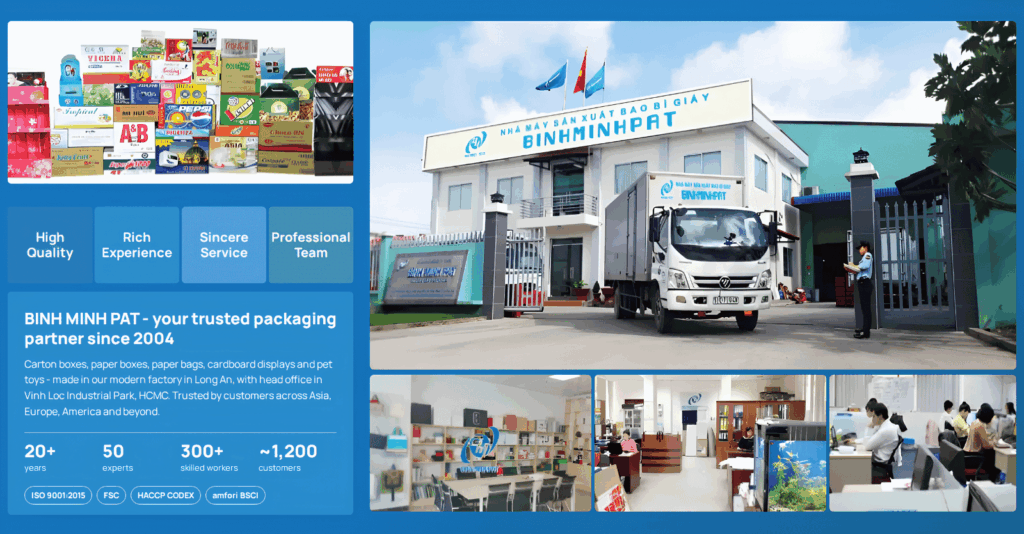
We have experiences in management of technology human and based on having ability of high technology, our production capacities are achieved by 100 million sqm/year for flexible packaging, by 20 million meters/year for sticker label, by 15 million sqm/year for corrugated box, by 55 million sqm/year for carton box and paper label.
With the commitment to customers, Binh Minh Pat Packaging Co., Ltd would like to offer the reasonable price, quick production and good service. We would like to co-operate and hope to have profitable mutually. All customers will be given a warm welcome when contacting us.

Service support where you need it
Get service support at any point of your packaging journey to guarantee total packaging success.

Consultation
Unlock the perfect package with our packaging experts! Get guidance on every step of your journey and make sure you get just what you need.

Design
Looking to launch a stunning new design or take an existing one up a notch? Our team of pros can elevate your artwork and
structural designs to extraordinary levels.

Prototype
Worried about your packaging prototype? Check out our range of flexible options to try before committing to mass production. Try it risk-free and save yourself time.

Production
Let our experts manage your production journey from start to finish – they’ll source the best materials and guarantee impeccable quality — a hassle free experience.

Logistic
Rest easy knowing that our expert logistics team has you covered when it comes to shipping. Get organized and save more with custom plans tailored for your needs!

Optimize
Discover the power of our optimization strategies, which can help you lower your time and cost spent on packaging while also improving sustainability!
Certifications

Contact Us
Any questions pls send emails to us or talk on Trademanager!

—————–
For further information, please contact us:
Binh Minh PAT Packaging Company Ltd.
Address: Lot A59/I Road 7, Vinh Loc Industrial Park, Binh Tan District, Ho Chi Minh City, Viet Nam
Hotline: +84 916 660 853 / +84 918 000 768
E-mail: info@binhminhpat.com Website: www.binhminhpackaging.vn
FAQ
Q: What about the lead time?
A: Sample lead time is 1-3 working days.Bulk lead time: 7-15 working days.
Q: What information is needed for price?
A: For price, we need to know your display size, printing requirement, load-bearing,quantity.
Q: What is yoursample cost?
A: Design for free, free sample (sample cost can be refund).
Q: What if I already have my own designs?
A: Great! Please send your file to let us know.
Q: What if I have no any ideas for my designs?
A: It doesn’t matter, we have a professional team having rich experience in cardboard display design and manufacturingjust tell us your requirements or your display and product specification, we do and customize the POS solutions with different designs for you until you are satisfied.
Recommended for you:
 FSC Certified Packaging: What It Means and Which Certifications Matter for Global Buyers
 Why Replacing Plastic Packaging With Corrugated Boxes: A Guide for Importers
 Wax-Dipped Cartons for Fresh Produce – 2027 Guide
 Double Sided Printed Boxes – Custom Paper Boxes and Corrugated Mailers Printed Inside and Out
 Shipping Boxes, Plain Boxes & Mailer Boxes
 Archive Storage Box: Sturdy Corrugated File Boxes for Offices, Records and Moving
 Cardboard Cat Scratcher Safety Standards: Why Cats Love Boxes and What Buyers Must Check
 Seafood Export Cartons from Vietnam: Standards, Specs and How to Choose the Right Box
 Custom Fruit Gift Box with Window: Vented Corrugated Packaging for Holiday Fruit Gifting
 Custom Cardboard Floor Displays for Retail – 2027 Guide